The Provincial Government of Camarines Sur, through the Provincial Disaster Risk and Reduction and Management Council (PDRRMC), started its crafting of a 10-year integrated Disaster Risk Reduction and Management (DRRM) and DRRM-in-Health Plan to further the preparedness and resiliency of the province in times of disasters.
Being located along the typhoon belt in the Pacific, typhoons occur very often in the Philippines. On average, 20 tropical cyclones enter the Philippine Area of Responsibility every year, and among the hardest hit regions of these cyclones is the Bicol Region. Correspondingly, according to Mines and Geosciences Bureau (MGB) Region V, Camarines Sur tops the list of provinces in Bicol Region that is susceptible to natural disasters. As such, CamSur’s PDRRMC has been devoted to ensuring the safety and adaptive capabilities of its people.
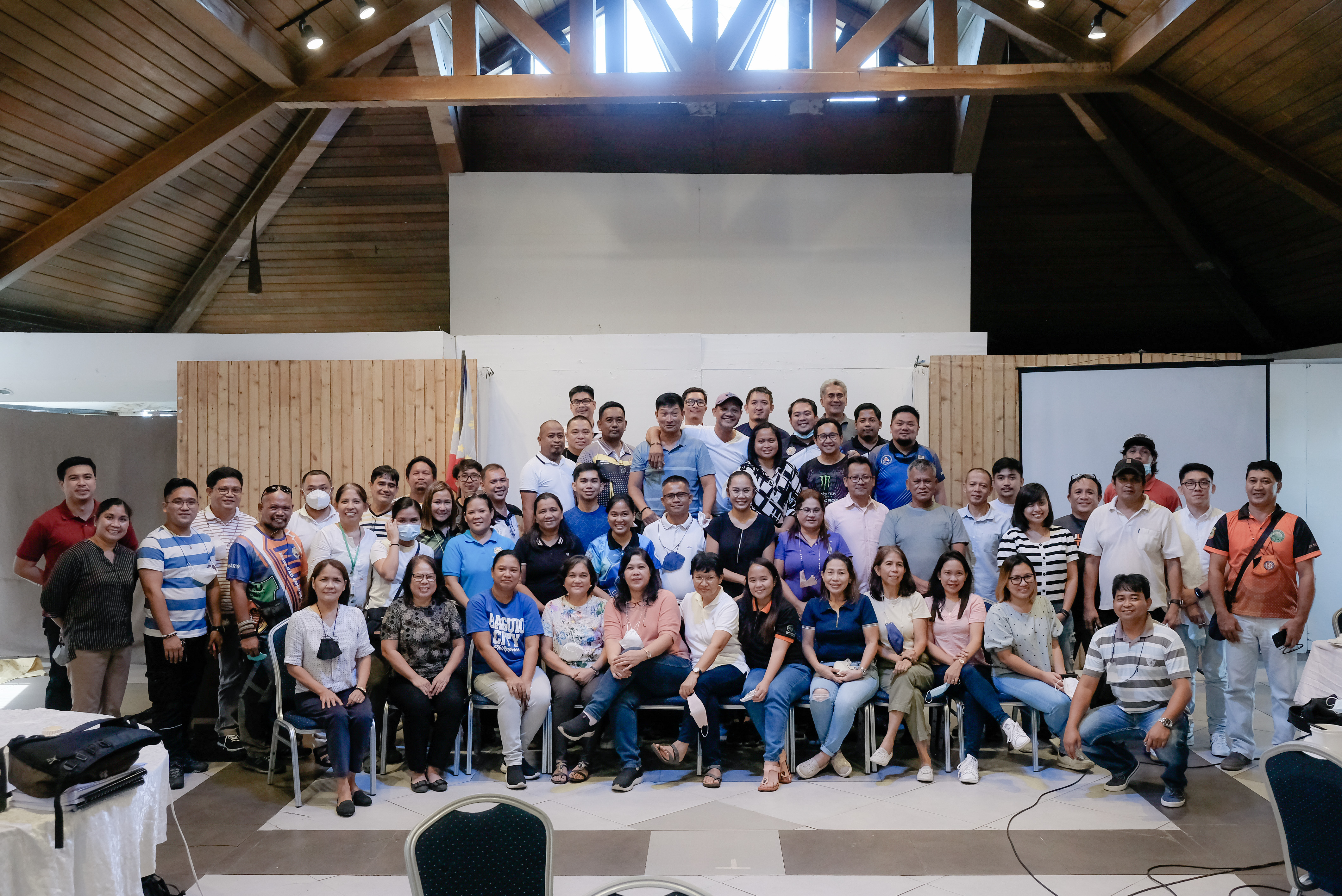
With the aim to formulate an integrated CamSur DRRM Plan for 2023-2033, a series of planning workshops and trainings were conducted by the Environment, Disaster Management, and Emergency Response Office (EDMERO) among the Municipal Disaster Risk Reduction and Management Officers (MDRRMOs), Municipal Health Officers (MHOs), and Sangguniang Kabataan (SK) Federation Presidents of the province.
During the planning workshop, an overview of the DRRM as well as the Provincial Risk Profile was discussed. The activity also focused on the assessment and identification of programs and projects for the four (4) thematic areas of DRRM, namely, Prevention and Mitigation, Preparedness, Response, and Rehabilitation and Recovery.
The activity served as an avenue for knowledge and expertise sharing between the MDRRMOs and MHOs to identify and bridge gaps to be able to incorporate DRRM-in-Health as an integral part of the 10-year DRRM plan. While the training held for the SK Federation Presidents became a capacity-building for the youth leaders to introduce and discuss with them the roles and responsibilities of the youth when it comes to DRRM and to provide them with a framework for the alignment of DRRM plans from the provincial level down to the barangay level.
“Having this activity is actually really good because we get to have initial contacts and communications with our MHOs. Despite having limited scopes and ideas when it comes to DRRM, it’s a good thing to sit together and plan, so can we can strengthen our collaboration, which will allow us to continue to foster better plans and policies,” remarked Lindel Van Rivera, LDRRMO III of LGU Sipocot.
Apart from harmonizing the plans of the local government units, the series of activities also aimed to lead them toward a common direction with one LGU, one response concept. With this closer collaboration, the PDRRMC will be able to maximize the utilization of limited resources, delegate tasks, and align plans with the national government.
To conclude and finalize the drafting of the plan, the PDRRMC convened its member-agencies to gather inputs for the development of the framework that will ensure a long-term response to all types of disasters.
Among the member-agencies present during the planning were from EDMERO, Provincial Health Office (PHO), Office of the Provincial Agriculturist (OPA), Provincial Internal Audit Office (PIAO), Provincial Treasurers Office (PTO), Provincial Budget Office (PBO), Provincial Engineers Office (PEO), Department of Science and Technology (DOST), Civil Aviation Authority of the Philippines (CAAP), Land Transportation Office (LTO), Provincial Accountants Office (PACCO), Sangguniang Panlalawigan (SP), National Food Authority (NFA), Department of Social Welfare and Development (DSWD), Department of Education (DepEd), Provincial Social Welfare and Development Office (PSWDO), Red Cross, Department of Health (DOH), Provincial General Services Office (PGSO), RED-TAG, Department of Public Works and Highways (DPWH), CASURECO, Provincial Planning and Development Office (PPDO), Department of Labor and Employment (DOLE), Department of Trade and Industry (DTI), Department of Agriculture (DA), Bureau of Fisheries and Aquatic Resources (BFAR), Department of Environment and Natural Resources (DENR), City Environment and Natural Resources Office (CENRO), El Verde Youth for Climate Action (EVYCA), Sagip Kalikasan Task Force (SKTF), CADRE, Gryphon Fire Volunteer and Rescue, Isarog Volunteer Environment Emergency Response Service (IVEERS), Boy Scouts of the Philippines (BSP), CARITAS, Department of the Interior and Local Government (DILG), Philippine Information Agency (PIA), Philippine Army (PA), Bureau of Fire Protection (BFP), Camarines Sur Police Provincial Office (CSPPO), Philippine Coast Guard (PCG), REACT, KABALIKAT, Neighborhood Watch Communications System Inc. (NEWACS), Department of Information and Communications Technology (DICT), Adventist Development and Relief Agency (ADRA), TESDA, Alliance of Ministries of Metro Naga Inc. (AMMNI), and Gawad Kalinga.
“DRRM is already established; however, health response, although we already know of and have, is not as formalized,” said Provincial DOH Officer of CamSur, Dr. Rey Millena. “The series of workshops is a good initiative to facilitate the integration of health response in DRRM and to also streamline the planning and response of each LGU,” he added.
Dr. Millena also noted the advantages and good outcomes of the 10-year plan, “By institutionalizing our systems and structures among the council, our response to disasters will be efficient. We can avoid redundancy and waste of resources because everyone is in place and aware of their roles and tasks within the council.”
With the PDRRMC’s 10-year integrated plan, the council will work toward transforming CamSur into a resilient province, ensuring zero casualties in times of disaster. The Provincial Government of CamSur, under Governor Luigi Villafuerte, is committed to strengthening its disaster response to lessen the adverse impacts of hazards, which will ultimately benefit the constituency of the province.